Like Chris Borland, Risk Not Worth Reward For Millions of Youth Players

BY BRIAN PATRICK HARMON

cropped-bph.jpg


When it comes to great sports moments, Hail Mary touchdowns can’t touch this. Walk-off home runs? Forget it. Even a March Madness buzzer-beater dulls in comparison.

Chris Borland’s retirement from the NFL blows them all away.

At 24, the San Francisco 49ers linebacker and budding superstar shocked his team and the league this week by retiring after his rookie season. Borland told ESPN’sOutside the Lines he is leaving the game to hopefully avoid the adverse health effects of repetitive head trauma.

Simply put, Borland has had his brain addled enough.

In looking out for himself, Borland has done a huge favor for the millions of youth and high school players banging their heads day in and day out, every fall across America. Perhaps, his retirement will tip the scales of awareness in favor of banning tackle football to children under 14 and away from letting the greedy NFL and NCAA continue to feast on the free minor league system that is youth football.

Research is increasingly showing that NFL players — 30 percent of whom will develop debilitating brain conditions according to a new study — do not have a monopoly on gridiron-related brain damage. Former pros who started playing tackle football before age 12 were significantly more likely to suffer with thinking and memory problems as adults, according to a Boston University study released in January.

Furthermore, scientists have discovered chronic traumatic encephalopathy (CTE) — a progressive degenerative disease of the brain found in people with a history of repetitive brain trauma — in deceased high school and college football players. Researchers at Boston University’s Center for the Study of Traumatic Encephalopathy say there is reason to believe CTE can begin when a child is very young.

Like virtually every NFL player, Borland’s success was built on the backs — and shaken brains — of hundreds of children, who didn’t measure up talent wise to Borland but whose participation was necessary for Borland to ply his trade as a hard-hitting, nose-on-the-ball wrecking machine.

To become great — and great he was in 2014, racking up more tackles per snap than any other player in the NFL — Borland needed high school teammates willing to be on the receiving end of his helmet-to-helmet strikes during practice and to “go to war” with him on game day.

And without opponents and organized leagues, Borland would not have had a stage to secure a football scholarship from Wisconsin and similar offers from other schools.

Very few players survive the football funnel through youth, high school and college to have the opportunity to play professionally on Sundays. But that doesn’t mean they all haven’t paid a dear price.

Walking away from millions of dollars, stardom and a dream job is nothing short of courageous. I consider Borland a hero.

Yet while his prudent decision is an effort to secure a healthy brain, there’s no guarantee that significant damage hasn’t already occurred deep inside Borland’s young skull.

Fortunately, Borland’s parents kept him out of football until he enrolled at Archbishop Alter High School in Kettering, Ohio. As a youth, Borland developed his athletic prowess playing what so many gorilla-minded youth football coaches label as “wussy” sports: tennis, soccer and baseball.

In a campaign funded by the NFL, USA Football’s “Heads Up Football” initiative aims to make football “better and safer” through concussion awareness, proper equipment fitting and heads up tackling.

There are two problems with this emphasis on heads up tackling. One is that it’s nothing new. Youth coaches have taught this for decades. Nowadays though, I suppose some dads just don’t cheer as hard for those loud ear-piercing cracks and pops caused by helmet-on-helmet contact.

The second issue I have with relying too much on heads up tackling lessons is that football is impossible to choreograph. At full speed and in the chaos that is football, heads duck and brains collide.

I suppose I suffer from buyer’s remorse when it comes to the game. I played youth, high school and college football and what I have to show for it are two herniated discs, a tendency to imagine myself clothesline tackling people who irk me and a nagging concern that my forgetfulness is connected to head trauma.

I also know that signing my son up to play tackle football a month before he entered kindergarten was foolish. How on Earth can a 5-year-old — or a child of any age up to 16 — make an informed decision to play football?

My son ended up playing 10 seasons — a decade’s worth of football. Every day, I hope the pounding he took and gave as a linebacker and fullback won’t affect his brain when he’s 20, 30 or at some point after I’m not around to witness it.

Chris Borland’s announcement can help spark an epiphany that leads to a ban on tackle football for children under 14 and removal of the sport from high school. Such progress will take litigation, legislation and perhaps educators and taxpayers asking, “What is the educational value of a sport that makes its participants less intelligent?”

Feature photo credit: Steve Schar

@theharmonizer

HBO Exec Receives Kidney Donation From College Friend

Originally published at stonybrook.edu  on March 10, 2015

BY BRIAN PATRICK HARMON

cropped-bph.jpgRobert Roth was on his back, staring up at fluorescent lights. His kidney transplant surgery was just moments away.

The HBO executive’s thoughts volleyed between his mom, who died three decades earlier from complications related to a kidney transplant, and his best friend, Stuart, who at the moment was across the hall having his left kidney harvested.

“It was almost one of those out-of-body experiences,” Roth, 58, said, “where you know what’s happening is real, but you can’t come to grips with the fact that momentarily, you will be cut open and your best friend’s organ will be placed inside of you.”

Roth met Stuart Zeitlin – the man who saved his life in December – during their first week as freshmen at Stony Brook University, back in 1973 when construction of the hospital and the Health Sciences Center was kicking off on the other side of Nicolls Road.

Zeitlin, then of Manhasset Hills, quickly struck up a friendship with Roth during his visits to see a high school pal a few doors down from Roth’s room in Irving College. Together with another freshman in the same residence hall – Kenny Cohen from Coney Island – Zeitlin and Roth formed a trio that remains intact today.

The three spent that fall sharing common interests, while pushing each other down the hall in shopping carts and rooting their hearts out for the New York Mets in the World Series. They then spent their lives cultivating their bond – graduating together from Stony Brook in 1977, serving as groomsmen in each other’s wedding parties, celebrating the births of each of their children, and making sure to routinely meet at Ben’s Kosher Deli in Greenvale for lunch or dinner.

“We had similar interests and similar backgrounds,” recalled Cohen, 59, who went on to medical school and is now a cardiologist in Lake Success. “We were part of the Stony Brook experience – when much of the campus was still being constructed and we had to walk through the mud and around piles of dirt to get to class. And we loved it.”

Cohen is credited with paving the way for Zeitlin, 59, to donate a kidney to Roth on December 18 at Yale-New Haven Hospital.

“Stu could hardly stand having blood drawn. The sight of blood had always made him queasy,” said Roth, who returned to work as Executive Vice President and CFO at HBO eight weeks after the operation.

“Stu was initially reluctant. Kenny was instrumental in getting Stu to realize that if there was any chance of finding a donor, he might be my best shot,” continued Roth, who personally and through HBO has generously supported Stony Brook and the Stony Brook Film Festival.

robertroth1

Robert Roth

Roth, who lives in Weston, Connecticut with his wife Linda, would not consider accepting a kidney donation from either of his two adult children. He said the risk would be too high for them, considering his type of kidney disease was hereditary.

Roth’s mother Blanche died at 59 within weeks of receiving a kidney transplant from a cadaver in 1985, and his brother Richard, a CNN correspondent, is living with a kidney transplanted 17 years ago from a deceased donor.

Cohen believed it was important to get the message across to Zeitlin – who like Roth has Type O blood – that donating a kidney is a low-risk procedure.

“You have to be by definition extremely healthy to donate a kidney,” said the heart doctor, who lives in Glen Head with his wife Hilari. “It’s absolutely proven that your lifespan is not affected at all. There are even some reports that say patients live longer because the donor feels so altruistic that it actually improves their health.”

Roth said it wasn’t long before Zeitlin, who has three adult children with his wife Judy and five grandchildren under 4, became “gung-ho” in his zeal to move ahead with the surgery.

On the day of the surgery, Roth and Zeitlin declined a ride to the hospital and instead made the short walk from their hotel.

“Rob and I laughed that it reminded us of the walks to the lecture center at Stony Brook or to the Light Engineering Building, where we took our calculus exams in 1973,” said Zeitlin, a sales manager with Big City/Danken Auto Parts in Brooklyn. “This time, however, the stakes were different and larger.”

Shortly after they were admitted at the hospital, Roth and Zeitlin were separated.

“We never had a chance to say goodbye or good luck,” said Zeitlin, whose operation began about 40 minutes before Roth’s.

In the moments before Zeitlin was wheeled into surgery, the North Bellmore grandfather said he felt relief that the operation was at hand because the “countdown to surgery” had become exhausting. But he was also very scared.

“I had never had surgery before – the nurse informed me that a bris, or circumcision, didn’t count,” quipped Zeitlin, the jokester of the three Stony Brook alums, before turning serious. “I was experiencing fear – fear of not waking up and fear of my kidney not taking in Rob.”

Four hours after the pensive pre-surgery moments for Zeitlin and Roth, they were both in recovery. Roth’s body was immediately adjusting to his friend’s kidney. The surgery was a success.

“I have a new lease on life because I had been living with a dark cloud over my head, knowing this was a degenerative condition and that I had very limited options,” said Roth. “Having Stu agree to do this was really like having a knight in shining armor. It is something I am eternally grateful for.”

KIDNEY

Stony Brook University alums (L to R) Dr. Ken Cohen, Stuart Zeitlin and Robert Roth at Yale-New Haven Hospital after Zeitlin donated a kidney to Roth. The three met as freshmen in 1973 at Stony Brook Univ.

Cohen calls Zeitlin, “a bona fide hero.”

“Stu was a guy afraid to give blood. Imagine the bravery it took to donate his kidney,” Cohen said. “Rob is blessed to have him as a friend. I’m blessed to have them both as friends.”

The three Stony Brook alums hope their kidney transplant story will inspire others to volunteer to be living organ donors.

“There is a tremendous shortage of kidneys. If we can get people to donate … you’re talking about thousands and thousands of lives to be saved,” Cohen said. “People who receive live kidneys do much better than those who receive one from a cadaver. We want to make people understand that it really can be done; that it is not as scary as it seems.”

STONY BROOK ALUM ‘ROCKS’ – AS AUTHOR AND SPORTS AGENT

BY BRIAN PATRICK HARMON

cropped-bph.jpg

He was a sick little boy pressing the hold button on real life.

Burton Rocks, then just 8, was alone on a stage at Stony Brook University’s Staller Center, performing the “Mickey Mouse March” on the piano and savoring a two-hour furlough from the hospital.

“It’s my earliest memory of Stony Brook and I’ll never forget it,” said the New York Times best-selling author who suffered severe childhood asthma before earning a history degree from the university in 1994.

“I was in the hospital that morning. My doctor said he’d release me and that if I didn’t feel well after the recital, he’d wait for me at the hospital,” continued Rocks, now 42. “I played my piece, wheezing the whole time, and finished to the cheers of my proud parents. Then, I went back to the hospital.”

Such was the routine for Rocks, whose chronic condition – he suffered three code blues before he turned 5 – landed him in hospitals throughout his time growing up on Seville Lane in Stony Brook.

At Stony Brook University, Rocks enrolled in the Honors College, where he began to cultivate his writing talents. His thesis project examining the effects of weight training on professional baseball served him well in his career endeavors as a writer and now, as a sports agent representing Major League Baseball managers, coaches, players and broadcasters.

“The Honors College was truly a catalyst for my writing career,” said Rocks, who wrote the 2003 bestseller “Me and My Dad: A Baseball Memoir” with retired New York Yankee Paul O’Neill. “Stony Brook was the perfect fit for me.”rocksoneill

“Hi. I’m Burton Rocks”

Jim Riggleman was the bench coach for the Washington Nationals and on a road trip in New York in 2009 when he received his first Burton Rocks call.

“I was sitting in my hotel room when he called to introduce himself,” Riggleman said. “He told me he knew people in broadcasting and that if I was interested in changing my career, he could represent me. You got to be thick-skinned to call out of the blue like that.”

The following summer, Rocks dialed up Riggleman again in his New York City hotel room.

“This time we were in town to play the Mets and I had become the Nationals’ interim manager,” Riggleman, 62, said. “A few months later, when the Nationals wanted to hire me as their permanent manager, I hired Burton and he negotiated an attractive contract for me.”

Rocks, who earned a law degree in 1997, scored his first big break in writing in 1999 when he collaborated with Clyde King, the longtime trusted baseball advisor to legendary New York Yankees owner George Steinbrenner, to co-author “A King’s Legacy: The Clyde King Story.”

He ventured away from sports in 2005, teaming with “Odd Couple” actor and sports fanatic Jack Klugman on “Tony and Me: A Story of Friendship.” It was Klugman’s tribute to his co-star, the late Tony Randall.

By the time Rocks had turned the page on his writing career and had committed to solely being a sports agent in 2007, Rocks had written eight books.

“Players who signed on with me said ‘If you were good enough to be Paul O’Neill’s teammate in writing his book, then you’re good enough to be on my team as an agent,’” said Rocks, recently hired as an adjunct business professor at Stony Brook.

Rocks will teach Business 391 – Management of Sports Organizations on Monday and Wednesday afternoons this fall.

“A good heart and spirit”

Retired Cincinnati Reds catcher Joe Oliver said it was Rocks’ “go get ’em’” attitude that sold him on the agent.

“He has a very positive outlook and a good heart and spirit,” added Oliver, 49, who Rocks helped get back into baseball as a minor league baseball manager after being away from baseball for over a decade.

Norma King, wife of the late Clyde King, praised Rocks for his perseverance. The Kings were close friends with Rocks’ parents and witnessed Burton Rocks’ struggle with asthma. As a favor to Rocks’ father, King gave Rocks an informal pitching tryout at King’s home in North Carolina while Rocks was in law school in 1995.

“Clyde always said ‘When one door closes, another door opens.’ Burton is living proof of that expression,” she said. “He threw for Clyde here (in Goldsboro, North Carolina). But his health precluded him from playing professionally. When that door closed, he turned to writing.”

Rocks credits his mother Marlene, a retired New York City schools Spanish teacher who serves as a translator for Rocks’ Spanish-speaking clients, and his father Lawrence, an acclaimed chemist and author of the 1973 tome “The Energy Crisis,” for helping inspire his success.

“It was very unique to see an agent show up with his mother,” said Todd Hankins, 24, a Cleveland Indians prospect who Rocks helped land a six-figure signing bonus in 2011. “Burton isn’t just worried about me making it to the big leagues and making money. He actually cares about me and my family.”

Staying Connected With Stony Brook

These days, Rocks enjoys visiting his alma mater, particularly for basketball games at Stony Brook’s new Island Federal Credit Union Arena.rocksbasketball

“I love attending the basketball games as an alum,” said Rocks, who brings his mother to some contests. “Seeing what (Stony Brook men’s basketball coach) Steve Pikiell and the basketball team have done to revitalize school spirit at Stony Brook is incredible.”

Rocks equated the jubilant atmosphere at the arena – including the “see of red” in the stands – to “a mini Madison Square Garden.”

“Seeing that would make any alum feel proud,” he added.

Rocks wants his story to inspire other Stony Brook alums and students in pursuit of their career dreams.

“I tell students that the road to being a sports agent can start many different ways and take many different turns,” he said. “My advice is to make yourself as unique as possible and to not let anybody discourage you. If you want to do something and have a passion for it, keep at it. Don’t get discouraged.”

Photo Credits: Feature photo, John Griffin. Secondary photo, Steve Pikiell twitter.

Story originally published at stonybrook.edu on March 4, 2015

Mike Golic’s Optimism for Safe Football Is Pure Fantasy

BY BRIAN PATRICK HARMON

I know a youth league football coach who once duct-taped his 10-year-old son’s wrists together for an entire practice to stop the aspiring quarterback from separating his palms when taking the snap from the center.

I know another coach who admonished his crying, belly-aching 8-year-old boy by shouting, “Unless there’s throw-up dripping from your face mask, get back in the huddle!”

And I can recall dozens of pee wee coaches and fathers downplaying a head injury sustained by a child on the football field by saying something akin to this age-old gem: “You’ll be fine. You just got your bell rung.”

Forgive my pessimism, but as long as football continues to attract these types of “You hit like a girl!” gorillas to teach the game to children, no amount of Heads Up football is going to make the sport safer.

USA Football bills its “Heads Up Football” campaign as a national initiative to help make the game “better and safer.” While emphasizing proper equipment fitting, concussion awareness and heads up tackling, the program is woefully deficient in its understanding of two important elements of youth football:

  1. The typical youth pee wee football league relies on minimally qualified individuals to volunteer to coach its teams. Passing a criminal background check and being able to get off work by 5 p.m. are basically all it takes.
  2. With football, chaos is at hand in virtually every play. Tackling is a car wreck; it’s impossible to choreograph heads-up collisions involving children — never mind college or NFL players — running full speed at each other.
2014-11-26-Golic3.jpg

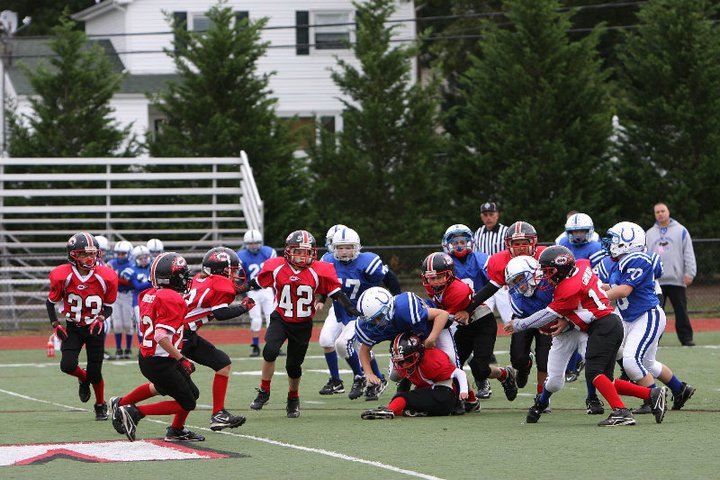
Helmet to helmet hits are unavoidable at every level.                                Credit: Eileen Torres

USA Football advises coaches to limit live contact as much as possible at practice. Sadly, there are leagues allowing teams — with players as young as 5 and 6 — to practice in full equipment in the middle of July.These completely unnecessary sessions typically are justified by gung-ho coaches who get their players’ parents fired up with Vince Lombardi quotes and an exclamation to the boys that “This is what champions are made of.”

Dude, relax. They’re first graders.

Former NFL defensive lineman Mike Golic has used his nationally syndicated radio program as a platform to spread the good word that Heads Up is making the sport safer and that the youth coaches of today are instilling fundamentals that will drastically decrease the amount of head injuries suffered by future NCAA and NFL players.

When LeBron James told ESPN.com that he does not let his sons, LeBron Jr., 10, and Maximus Bryce, 7, play football, Golic, on a “Love it or Shove it” segment of ESPN Radio’s Mike & Mike, reacted with a rant about football safety.

“I completely shove it,” Golic said of James’ statement. “Football to me, especially at the youth league (level) is as safe as it’s ever been. There is such a premium on… concussion awareness, on equipment fitting, on proper tackling. Kids are learning to hit the right way. The next generation of our players are going to tackle better, and have better fundamentals, and have better technique… and hopefully not get hurt.”

This is pure fantasy. Considering that youth leagues and school districts cannot possibly afford what it takes to make the game safer — proper coaching training, certified medical personnel at every game and state of the art helmets and other equipment — Golic’s vision of a brighter and less injurious day for football is a pipe dream.

2014-11-26-golic2.jpg

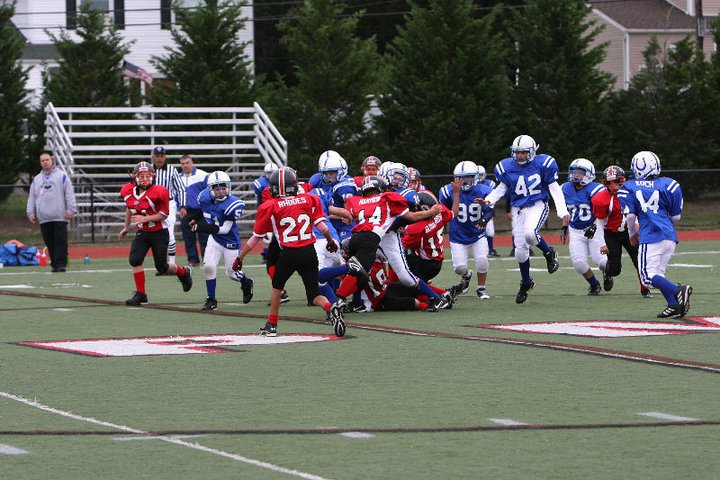
Tackling is a car wreck. There is no way to choreograph it. Credit: Eileen Torres

And really, even if all of those measures are taken, tackle football, given its combative objectives, can never be deemed “safe.”

But that won’t stop the NFL — which has acknowledged in federal court papers thatone in three NFL players will develop neurological problems at “notably younger ages”— from trying to convince the populace that football is safe enough.

In what seems an obvious reaction to a recent decline in youth league participation, the league has held dozens of “Moms Football Safety Clinics” at NFL cities across the country. The clinics run mothers through tackling drills, provide concussion awareness education and deliver instruction on helmet fitting.

Golic talks about the clinics on his radio show, mentioning that his wife Christine speaks at the clinic as an ambassador for the NFL and the Heads Up initiative.

“We want to assure mothers that the game is safer and better than ever before. We want them to participate,” Christine Golic, whose two sons played football at Notre Dame, told the Detroit Free Press after speaking at a clinic hosted by the Detroit Lions.

Ignorance is bliss, and clearly the Golics are akin to it.

Cover Photo Credit: Steve Baker

Long Island Rail Road Moments That Tug At The Heartstrings

BY BRIAN PATRICK HARMON

The electrician and the sleepy attorney have commuted home on the train to the same station for some time — probably for years — but I doubt they had acknowledged each other before this moment:

“Hey, pal. We’re in Bay Shore,” the tough-looking contractor says in a soft but assertive tone while alerting the napping litigator with a gentle nudge on the arm.

For four years, I spent over three-and-a-half hours a day riding the Long Island Rail Road to work in Brooklyn. Riders always had plenty to whine about — what with the delays, the shutdowns and the steep ticket prices that always seemed on the verge of being hiked. But for those riders who pick their heads up from their smart phones now and then, there are plenty of feel-good moments to be seen and heard.

I once watched two riders team up to map out the quickest way to reach Jamaica via subway from Atlantic Terminal in Brooklyn, after word spread that railroad service west of Jamaica was shut down “indefinitely.” Believe me, I have tried this, and it’s no picnic.

The two men analyzed the giant subway grid on the wall, then weighed the friendly and a bit too ample advice of a disheveled passerby. Finally, they walked to the Lafayette Avenue subway station.

There, they chatted about work and commuting before catching an A train to Broadway Junction, where they ambled up the steps to the elevated platform and soon boarded a J train bound for Jamaica. The two stayed by each other’s side until they boarded a LIRR train in Jamaica.

Romance — depending on its form — is nice to witness on the train. One rainy evening commute home, I caught a glance of a smartly dressed middle-aged man standing under an umbrella on the Islip station platform.

My train crept to a stop and I got a little choked up as the train door slid open right in front of where the man was standing and a woman stepped out into a warm embrace with the man before the two clasped hands and walk down the platform stairs. As the train pulled away, I watched the man gently guide the woman to the passenger door of his car. In a flash, they were out of sight.

What made this so heartwarming was that it was clearly a daily routine. How else would the man know just where to stand on the platform to greet his lady friend?

On another commute home, it was sure nice to find a $20 bill on the floor of the train, even though I may have pounced on it a little too fast. Out of guilt, I asked the nearest person, “Does this belong to you?”

He said, “No.” That was good. Good to find the 20 bucks, good to keep it and good that the man was honest.

The train was always good for chance encounters with old friends. For me, it was bumping into a former Daily News colleague, a high school football teammate or a fellow parent from my time living in Bethpage.

It was always a pleasure bumping into the coach of my daughter’s soccer team on the ride into work. Bob and I boarded in Patchogue, but Bob would hop off the train 20 minutes later for work in Babylon.

Commutes with Coach Bob represent the best of both worlds for me. I get just enough stimulating conversation before Bob’s stop. Then, when he’s off, I’m able to kick back, read the paper and tinker with my iPhone.

It was a pleasure watching old friends meet and hug. And it was nice to see a young family board the train together, embarking on an exciting trip to The City. They worry about things most commuters don’t: Should we sit in a seat facing the direction we’re traveling in? Do we change in Jamaica? What time do we arrive at Penn Station?

I frequently saw regular riders switch their seats on the train to make room for a couple or a family to sit together.

It was wonderful to see a regular rider who speaks fluent Spanish step in to serve as translator between a conductor and an elderly Hispanic man who had boarded a train without a ticket. The Hispanic man clearly did not understand the conductor’s English – even when the conductor spoke very loud and very, very slow.

From what I could tell, the amateur interpreter asked the man in Spanish, “What station are you getting off at?” I was able to make out “qué estación.”

The man replied, “Jamaica.” Then she informed him — in Spanish of course — that if he didn’t have money for a ticket, the conductor needed to see “identificación.”

The man quickly dug up his I.D. and the last I saw of him, he was on the platform filling out paperwork.

It was especially good to see common sense prevail on the train, like when a regular rider realized it’s a new month, but was already on an evening train back to Long Island and hadn’t purchased his monthly ticket. When the conductor came around to check tickets, the rider barely uttered the syllable “for-” in the word “forgetting,” before the conductor recognized him and quietly agreed to give the guy a pass for the ride home.

What makes the LIRR good — even great — on many days are the riders. Sure, they can be cranky and gruff and want their quiet and their space, but given the opportunity to reveal their goodness, they rise to the occasion again and again.

*This an updated version of my column that ran in the Riverhead News-Review on April 7, 2012.*

Photo credit: Emmanuel Nicolas

Royals Run Recalls Memories of Rooting Against the Dreaded New York Yankees

BY BRIAN PATRICK HARMON

Their center fielder introduced me to the beauty of an inside-the-park home run. Their submarine closer seemed to scrape his knuckles on the mound with every pitch. And one of their shortstops played with a toothpick dangling from his mouth.

They were the Kansas City Royals of the late 1970s and early 1980s, a talented and character-laden team that hit, ran and pitched their way to six division crowns in a 10-year span, ultimately winning the franchise’s first World Series in 1985.

Often, these Royals were the last team standing in the way of yet another World Series appearance for the New York Yankees. And as such, in my family, they were a team worth rooting for.

It was a drag being a young diehard New York Mets fan during the Carter Administration – back when Joe Torre was cutting his eventual Hall of Fame skipper’s teeth as the Amazins’ manager. For seven consecutive seasons, the Mets finished last or next-to-last in the National League East.

So come October – certainly if I wanted to stay in the good graces of my grandfather – the team to pull for was whichever team was facing the Yankees in the playoffs.

It certainly didn’t seem like such a good idea in 1976. That was when I watched with my little mouth agape as Yankees first-baseman Chris Chambliss slugged a walk-off homer in the decisive Game 5 win over the Royals in the American League Championship and somehow made it around the bases in spite of the thousands of frenzied fans that had stormed the field at Yankee Stadium.

It didn’t get better in 1977 or 1978. The Yankees eliminated the Royals in the playoffs those seasons too. Kansas City finally defeated the Yankees in a playoff series in 1980 and reached its first World Series.

So embarrassed by the loss was Yankees owner George Steinbrenner that he fired his manager Dick Howser, even after the team won 103 games during the regular season. Stuff like that made it easy to root against the Yanks.

A bit of irony: Howser managed Kansas City when they defeated cross-state rival St. Louis in the 1985 World Series.

I certainly hadn’t given those Royals teams much thought over the last three decades, not with the Royals holding court at the bottom of the American League standings season after season. But the team’s rocket ride through the playoffs this season got me thinking about the players on those consistently good Royals teams.

At the top of the list is Willie Wilson, the Royals fleet-footed center fielder from 1977 to 1986, whose blinding speed turned some games into track meets. I still see him in my mind lacing one in the gap at the then-Royals Stadium and whirling around the bases for a game-winning inside-the-park home run in an extra-inning game with the Yankees. He hit a total of 13 inside-the-park homers.

It’s easy to recall watching reliever Dan Quisenberry – the perennial Rolaids Relief Man in the American League – closing win after win with his submarine delivery.

U.L. Washington was the Royals shortstop who played with a toothpick in the corner of his mouth at the plate and in the field. He switched to a Q-tip when parents of youth players complained.

But who can forget that? I still have baseball cards with U.L. slyly grinning and chomping on a toothpick.

I challenged myself to remember the regulars from the 1976 team. I came up with seven of the nine regulars and managed to accurately name four starting pitchers, Paul Splitorff, Dennis Leonard, Doug Bird and Andy Hassler.

I thought for sure that Darrell Porter was the Royals catcher that season, but my research at mlb.com revealed he didn’t arrive in Kansas City until 1977. As it turned out, Buck Martinez and Bob Stinson shared time behind the plate in 1976.

Right field was the only other gap in my memory for the starters on that 1976 team. Al Cowens, who finished second in voting for the American League MVP award in 1977 was Kansas City’s regular right fielder from 1974 to 1979. Missing his name smarted.

Of course, it was easy to remember George Brett — who hit .390 in 1980 and seemed to win the American League batting title every year Twins and Angels star Rod Carew didn’t — being the heart and soul of the team. He was Kansas City’s third-baseman for 21 seasons.

The 1976 team was solid up the middle with center fielder Amos Otis; shortstop Freddie Patek, who standing 5-foot-five was the shortest player of his time; and longtime Royals second-baseman Frank White.

Big John Mayberry was the slugging first-baseman, Hal McRae was the clutch-hitting DH and Tom Poquette was the journey-man leftfielder for the 1976 squad.

Brett, White, McRae and Wilson, who played sparingly as a rookie in 1976, were still key contributors on the 1985 team that won it all.

Here’s hoping their re-appearance in the World Series this year is an omen of things to come in the 2015 season for my Mets, who won the World Series in 1986.

With Football and Hazing, History Repeats Itself

By BRIAN PATRICK HARMON

It was theater in its ugliest form:

Two half-naked freshman football players being forced by teammates twice their size to lick each other’s nipples.

An audience that by most accounts exceeded a dozen players eagerly watched the degradation – and cheered. It only got worse – far worse – for the pint-size 13-year-olds.

Next came demands to simulate oral sex on a banana held against the groin of one of the three attackers – much to the delight of the ogling crowd. Then, the ringleader in this varsity trio lowered the hazing attack to new depths.

Witnesses said that with rock music blaring and duct tape at the ready to drown out the screams, a hulking 16-year-old lineman grabbed a broomstick and dipped it in Mineral Ice.

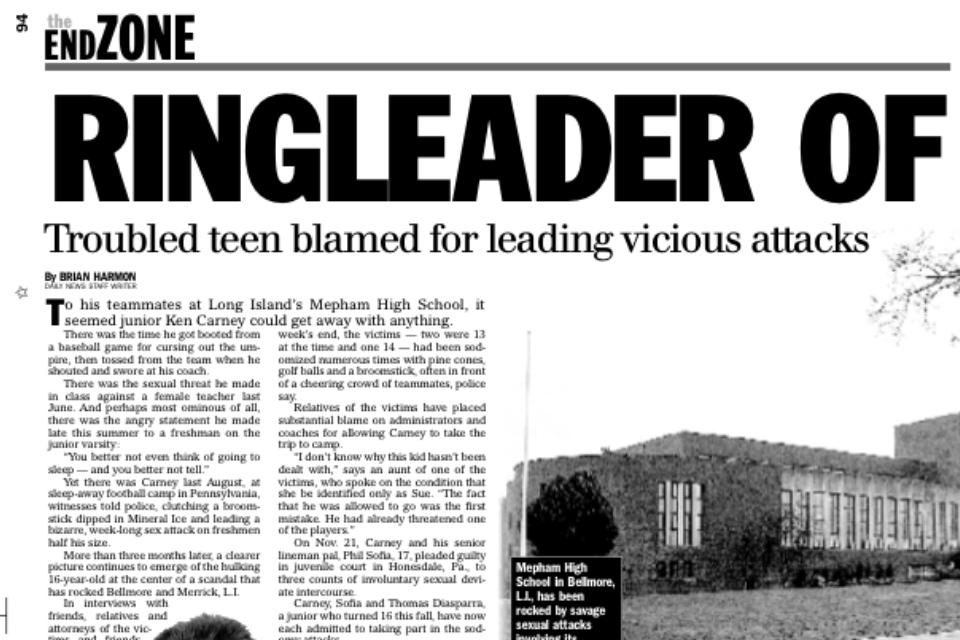
This was part of the horrific pre-season football camp scene in August 2003 that landed three upperclassmen from Long Island’s Mepham High School in jail and led to the cancellation of Mepham’s football season. The depiction above – describing one of the many attacks on Mepham freshmen inside a cabin at a sleep-away camp in Honesdale, Pa. – kicked off a story I wrote back then, as a reporter for New York’s Daily News.

The paper, committed to being the first media outlet to identify the teens accused in the attacks, wanted to deliver a strong, compelling story. Editors said the writing and reporting were fine, but what I submitted was too strong. What did get published was a version that toned down the details and pulled back on the drama, but was nonetheless influential in that it named the accused.

2014-10-11-mepham3.png

Daily News Dec. 21, 2003

The details that began to emerge last week of the alleged hazing attacks involving members of New Jersey’s Sayreville War Memorial High School football team are no less shocking. This fall – before school district administrators appropriately cancelled the remainder of the season on Oct. 7 – freshman football players were routinely subjected to sexual attacks carried out by seniors during a locker room ritual, police said.

Seven players – aged 15 to 17 – were criminally charged Oct. 10 for their involvement in sexual assaults on younger players. One parent, informed by his son, told a reporter with NJ Advance Media for NJ.com that a victim would be held by multiple older players while a finger was inserted into his rectum. The same finger was sometimes placed in the freshman’s mouth, according to the NJ.com report.

At the time of the arrests, the coaches – except the assistant arrested for steroids possession a week before the hazing story broke – still had their jobs.

Hazing – in varying degrees of severity – exists at all levels of team sports. In the NFL, summer camps each year yield images of rookies wrapped and immobilized by yards and yards of athletic tape.

Last month, rookies across Major League Baseball were encouraged by the veterans on their respective teams to carry out goofy public acts. On the team’s website, the New York Mets proudly posted embarrassing photos of sheepish-looking rookies pushed into parading around the clubhouse dressed in feminine super hero costumes.

Given how widespread hazing is, it cannot be eliminated. And nor should it be – so long as it’s all in good fun, it’s not dangerous and the participants are willing. However, it should be carefully monitored and contained, particularly at the high school level.

Coaches may want to rein in the seemingly good-natured hazing that calls on freshmen to clean the field or carry off all the equipment after practice. Simply because this type of delegating makes an impression on young minds that the lowerclassman is something lesser than the rest of the team.

Another factor to consider is that when a school team’s hazing customs go unchecked, the bullying will grow more degrading every season. In many instances, each class looks to top its predecessor.

Consider that during Mepham football’s 2002 pre-season camp, the worst hazing act was a swirly, which involves holding someone upside down and dipping the person’s head into a toilet bowl as it is flushed.

Seems mild when you look at what happened at their camp in 2003.

With one 250-pound lineman sitting on top of the fully-naked victim, the equally beefy ringleader of the Mepham hazing attack began violating the freshman with a broomstick that had been dipped in Mineral Ice. Duct-tape muffled the screams. Laughter from the spectators and the beat of the music took care of the muffles.

Back and forth, the attackers bounced between two freshmen. Friends since kindergarten, the two teen victims were now linked as objects facing bizarre brutality.

Similar attacks were repeated throughout the five-day camp, with the attackers adding beatings and pine cones and golf balls to their sadistic repertoire. Those objects were also dipped in Mineral Ice.

By some accounts, the attackers grew tired of the assault and allowed the victims to return to their bunks with golf balls still inside them.

2014-10-11-mepham1.jpg

2014-10-11-mepham2.jpg
Wayne County, Pa., court documents

Photo: By trowel317 via Flickr

High School Football Deaths Stir Disturbing Memories of Youth Football

BY BRIAN PATRICK HARMON

What follows is a true American football moment. It happened on Long Island.

“Break his leg! Break his f—ing leg!”

It was the waning moments of a damp September fourth quarter, and football, as it often does, had brought out the ugly side of one of its fans. In this case, the red-faced rooter was a 30-something dad imploring his son, an outside linebacker, to maim the opposition’s running back.

The boys playing were nine and 10. Fifth grade. Pee wees.

The father wasn’t a coach. Nor was he one of the three volunteers holding the yard markers. But there he was, stomping along the sideline, ensuring junior could hear dad’s commands.

2014-10-04-footballphoto3.jpg

Credit: Eileen Torres


I can only surmise that this man’s sideline presence and profanity were permitted because his place of business hosted end-of-season award parties for teams in the local pee-wee league. Perhaps, his bulging biceps and the veins popping from his neck also played a role.

Similarly boorish was the head coach of the team this father was pulling for. His own son had an intense fear of football’s most basic requirement – hitting. To remedy this lack of meanness, the coach took several drastic measures.

Two were especially disturbing.

During practice, he routinely would sic the two most aggressive players on the team against his son during full-contact drills. “Again,” he shouted, each time his son wound up on the wrong end of a ferocious pummeling. Yes, some 10-year-old’s hits are ferocious.

“Don’t help him up,” the coach would add. Only after the tears flowed from his son’s eyes did this moronic exercise cease.

As if this wasn’t enough to encourage his son to hate him (and football), the coach had the same two boys come to his home to engage in hitting drills with his son in the backyard. This time – the coach bragged to me – the drills continued in spite of his son’s crying.

The coach wasn’t much nicer to the rest of his players. Random and nonsensical screaming were the norm during practices. And his sideline griping at games was legendary in its filth, particularly those times when his team fell a “c— hair” short of reaching a first-down.

Taught and played correctly, football is an incredibly violent game, where the threat of serious injury hovers over every single play. Even the kookiest football parents – the ones that spew blood-curdling screams and howl like wolves when their sons do them proud with big hits and long runs – fear the worst during games and are thankful after every play that their son doesn’t need to be carried off the field.

So when you add irresponsible parents masquerading as coaches to the sport, the results are frightening.

From youth leagues to the National Football League, inspiring, compassionate and sensible coaches are abundant at every level of the grid-iron food chain. But so are the ignorant, selfish and immoral ones.

Coach Brady Hoke at the University of Michigan has been widely criticized for allowing his wobbly sophomore quarterback Shane Morris to remain in the Wolverines’ home game Saturday, Sept. 27, against Minnesota after a crushing hit that left him stumbling, dazed and obviously concussed.

Students and other fans are calling for Hoke’s job. Though, sadly, they really want Hoke axed more because his team is lousy than because of the way he handled his quarterback. Still, a team as big as Michigan’s has dozens of coaches and trainers. Someone should have acted fiercely enough to keep the injured Morris off the field.

When the news flashed on my phone Wednesday night that 16-year-old Tom Cutinelladied after a violent collision playing football for Shoreham-Wading River High Schoolin Long Island, New York, I was horrified. My thoughts quickly raced to my teenage son, sleeping in the bedroom down the hall. He wasn’t yet five and barely 40 pounds when he started playing tackle football.

2014-10-04-harmonblogpost1.jpg

Credit: Eileen Torres

Outwardly, he enjoyed the game, getting high praise for wild touchdown runs and earning monikers like “assassin” and “terminator” for big hits. But after 10 seasons in helmet and pads, this summer he asserted he would not be playing this fall.

I was quite concerned with what he’d do with his time after school, but my gut reaction was relief – intense relief. Join the golf team, I suggested.

I helped coach my son’s youth league teams and I shake my head at some of the tackling and blocking drills I ran my players through. Looking to instill a toughness in little kids who wanted no part of colliding full speed with another child, I reasoned that I was protecting them – that they would be more likely to get injured if they played with fear.

I should have suggested their parents pull them from football and ask for their money back from the league.

Many people are reasoning that deaths like Tom Cutinella’s are random. But can it really be a surprise that now and then a child is killed playing a sport where players are dressed like modern day gladiators and success is predicated on which team hits harder? Also, consider that NFL teams erect statues of legends who were essentially paid concussionists, i.e. the Baltimore Ravens’ Ray Lewis.

There’s a magic in playing football. The game offers discipline and serves up powerful lessons in perseverance. And then there’s the camaraderie that you cherish for a lifetime. There’s a one-of-a-kind adrenaline rush that comes from battling with all you have alongside your teammates.

Whether we won or lost, I wouldn’t trade my football teammates from high school or college for anyone else.

2014-10-04-harmoncollegeball.jpg

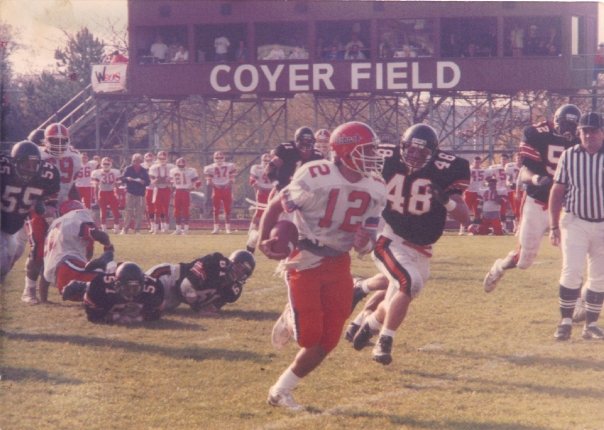
This is from 1990 when I was a senior outside linebacker for Buffalo State College. I am #48 chasing down the Hobart quarterback. Source: Buffalo State College

As a player and as a coach, I was under football’s spell for a long time. But the mounting data documenting the sport’s adverse health effects, along with the NFL’s handling of domestic abuse cases and the fact that college athletes still get no share of college sports’ $11 billion in annual revenue has broken the enchantment.

Clearly, with hundreds and hundreds of billions tied up in television contracts for college and pro football and with millions of fans attending games at all levels each week, football doesn’t need me.

But for the sake of its players, young and old, it needs some change. Here are some suggestions:

  • Mandatory training for youth football coaches.
  • Be certain youth players have properly fitting equipment, including a molded mouthpiece.
  • Require that certified trainers be present at every game played.
  • Ban tackle football to children under 12.
  • Eliminate for-profit youth football leagues.
  • Compensate college players financially – with at least something. Whether they’re a practice squad player or a Heisman Trophy winner, they’re all sacrificing blood, sweat and untold physical damage, while their coaches earn millions in salaries and endorsements and their schools rake in billions in revenue.

theharmonizer@gmail.com

@theharmonizer

Continue reading

We Can’t Ignore Kids and Concussions

BY BRIAN PATRICK HARMON

cropped-bph.jpgA few weeks ago, my dad apologized for all the smoking he did in the house back when I was a kid.

“We just didn’t realize,” he said as we watched the little girl on the anti-smoking commercial cough into a room thick with secondhand smoke.

I’ve heard that refrain many times through the years. From my parents. From my aunts. From a ton of reformed smokers. That excuse — the lack of awareness of the dangers of secondhand smoke — has always rung hollow with me. As if my bloodshot eyes and hacking cough weren’t strong enough hints that breathing that stuff in was detrimental.

These days, I am beginning to seriously ponder if I will someday make a similar mea culpa to my son. Dan is 12 and has already played eight seasons of tackle football. He was an aggressive little guy, loved roughhousing, jumping around and knocking into stuff, so as he was heading into kindergarten — and a few months shy of turning 5 — I signed him up for peewee football.

In terms of catching, running and throwing, Danny has done some amazing things playing football. But he is particularly noted for his “pancake” blocks and bone-crushing tackles, the type of hitting that led to such scary nicknames as “Terminator” and “Assassin” from his coaches. My son’s ego feeds off the attention he receives for his warrior mentality.

Junior Seau was a force on the grid iron. Credit: Flickr

Junior Seau was a force on the grid iron.
Credit: Flickr

I imagine Junior Seau experienced the same motivation while growing up menacing whoever crossed his path on the football field. Seau was the warrior’s warrior. The fire in his eyes alone was enough to lead his teammates into battle. In a game dependent on violence for fan interest, Seau was as fierce as they come. He hit — and was hit — for 20 seasons as an NFL linebacker.

Seau’s suicide last week should be a wake-up call for any father who pressures his son to play football and for any coach who pressures his players to play with a head injury. Seau shot himself in the heart. Like fellow NFL great Dave Duerson, who similarly killed himself in 2011, Seau — who suffered multiple concussions playing football — clearly wanted researchers to study his brain for trauma. It’s been documented that Seau had been suffering from depression in recent years. It would be irresponsible not to suggest that his depression was influenced by repeated blows to the head.

Among the institutions in line to study Seau’s brain is Boston University’s Center for the Study of Traumatic Encephalopathy, the research center that found Duerson, a longtime Chicago Bears safety, suffered from chronic traumatic encephalopathy (CTE) — brain damage — due to repeated hits to his head. CTE is not exclusive to NFL players. Boston University researchers found CTE in the brain of an 18-year-old athlete who had sustained multiple concussions.

This memorial to Junior Seau shows the outpouring  of love and support that came in wake of the linebacker's 2012 suicide. He donated his brain to science.  Credit: Tejas Califas

This memorial to Junior Seau shows the outpouring of love and support that came in wake of the linebacker’s 2012 suicide. He donated his brain to science.
Credit: Tejas Califas

Pain tolerance is among the core values of football. It’s a game where you’re rewarded for how much you can tolerate. Players — not just those getting paid or on scholarship — will go through anything to stay on the field.

I am certain that I played the last game of my junior season of college football with a concussion I had suffered days earlier during practice. My motivation: I wasn’t going to jeopardize my starting position by letting a headache and some dizziness keep me out of the game.

Awareness of the dangers of head injuries has increased on the youth football level. But there is still precious little medical oversight at practices and games.

Youth leagues need a trainer on-site to evaluate head and other injuries — to determine if it’s safe for a child to continue playing. It is worth the increase in registration fees.

Furthermore, leagues, coaches and parents should limit the amount of full-contact football a child plays during the year. Too many kids on Long Island play tackle football eight months a year.

youthball

Youth football leagues across the country fall woefully short in monitoring head injuries. Photo from Flickr

Ridiculously, coaches begin full equipment practices for the fall season in July. Then, when the fall season ends in November, the indoor football season begins in December with teams registering to compete in for-profit youth leagues that schedule playoff games deep into February.

Hundreds of retired players — including Hall of Famer Tony Dorsett — are suing the NFL for negligence, accusing the league of deception and denial in failing to properly inform players of the link between head injuries and long-term cognitive brain damage.

If players have a solid case against the NFL, then how strong of a case would former youth and high school players have against their leagues, or worse, their dads?

I recall hearing about the first case of ailing smokers suing Big Tobacco in the 1990s and thinking that the smokers had no case, that they should hold themselves accountable for willingly embracing the risks of smoking cigarettes. How completely wrong I was.

Is it so far-fetched to imagine non-NFL players suing the league for selling a product that influenced them to make poor health decisions on the playing field?

Originally published in the Riverhead News-Review on May 12, 2012.

Fearing she’ll be parked behind bars. . . Lizzie drops the bawl

Originally published in the Daily News on July 19, 2002

BY BRIAN PATRICK HARMON

Lizzie Grubman became the Princess of Wails yesterday, crying for forgiveness outside a Long Island courtroom.

Amid heaving sobs, she broke a year-long silence in the Hamptons crash that now has the poor little rich girl headed for a criminal trial.

“I just want to say how absolutely sorry I am that innocent people got hurt that night,” Grubman, 31, told a crushing throng of reporters at the Suffolk County Court in Riverhead. “Please tell them and please tell their families how terrible I feel. I’ve felt this way since this happened. I’m so sorry.”

At that point, her words collapsed into heaving sobs, and she continued to bawl as her lawyers and new media adviser led her to an elevator and out of the courthouse to a waiting chauffeured car.

But Grubman’s weepy display seemed like crocodile tears to lawyers representing some of those who were injured when she backed her Mercedes SUV into a Hamptons nightclub crowd in July 2001.

Coached to cry?

One plaintiff’s lawyer suggested Grubman likely had been coached by her recently hired public relations guru, Dan Klores, who represented Sean (Puffy) Combs during his criminal trial last year. Another said he believes the apology – her first since her mea culpa in the days immediately after the July 7, 2001, crash – was an attempt to soften Grubman’s image, as well as a show of remorse for potential jurors on Long Island’s East End.

“It’s interesting her apology was made at the time a plea deal falls apart and she knows she’s going to trial,” said Anthony Gair, whose client Adam Wacht suffered a serious leg injury in the crash outside Southampton’s Conscience Point Inn.

“You’ll notice in her words that there is no taking of responsibility for an act that was absolutely her fault,” Gair said. “I wonder whether it’s directed to the victims of her actions or to a potential jury pool.”

Nassau County Assistant District Attorney Joy Watson, the special prosecutor handling the case, also was unimpressed by the apology.

“The time to express her concern was that night. She should have stuck around and rendered assistance to the victims,” Watson said.

Grubman is charged with backing the SUV into a crowd of clubgoers, injuring 16 people. She pleaded not guilty in September to a 26-count indictment that included second- and third-degree assault, vehicular assault, leaving the scene of an accident – all felonies – and operating a motor vehicle while under the influence of alcohol, a misdemeanor. She faces up to eight years in prison if convicted.

For months, her lawyers tried to arrange a plea bargain that would result in little or no jail time. Judge John Mullin said yesterday he will set a trial date when Grubman returns to his courtroom Aug. 16. But he noted that he is retiring before the year ends and expects to hand the case off to a different judge, which means the trial is unlikely to begin until January.

Anxious in court

Grubman, whose long blond hair cascaded over a powder blue pants suit, seemed unnerved from the time she arrived at court with an entourage of lawyers, bodyguards and friends yesterday. She was a tense figure in Mullin’s packed courtroom, waiting for her case to be called. Her lead attorney, Stephen Scaring, repeatedly urged her to relax. When she left the courtroom, Grubman, the daughter of entertainment lawyer Allen Grubman, pleaded with Scaring to let her make a statement to the press.

“Lizzie, no,” Scaring said. But Grubman persisted: “I’d like to say something, please.”

Scaring appeared uncomfortable, but said, “Okay.”

Then Grubman addressed the media, a task she normally would handle with ease in her job, and began crying.